Stan: You know the story behind The Great Escape movie?
Dan: Yes, it was quite daring for all those POWs to escape at once.
Stan: Well, they didn't allow any corporals to work on the digging process.
Dan: Seems silly, why is that?
Stan: Because they would have developed corporal tunnel syndrome.
Thursday, June 21, 2012


Monday, June 18, 2012
Condensed American Political Tradition (1620-1783)
The class POSI 2310 is required for all undergraduates at my university in the state of Texas. It could very well be renamed "Early American Political Documents," because that represents the entire body of the course, with no attention paid to figures, maps, statistics, speeches, pictures, stories, or legends. One can actually gain a large degree of familiarity with the American political tradition by following just a half-dozen or so important documents.
A note on American documentary history: Unlike the edicts of French kings or the mandates of Russian tsars or Japanese shoguns, there is not much precedent (or acceptance) in America of laws and constitutions and acts being imposed upon them. When a document is produced officially, it usually represents laborious debate, often overcoming overwhelming opposition at the start. Despite this, the message is usually fairly clear, and (at least for the examples you are about to look at) relatively short and readable.
This post discusses some of the documents we studied. The remainder will come in the follow-up post.
This document was created by the settlers of the Plymouth colony in present-day Massachusetts upon the second-ever successful colonization effort by the English (Jamestown in 1607 was first). The Mayflower carried 101 settlers, including many women and children. The 41 signers of this document included the majority of the adult males aboard the ship. In the very first line the signers describe themselves as "loyall Subjects of our dread soveraigne Lord King James." This implies that they were eager to assert that they remained loyal to the King, even if they felt persecuted enough for their religious heterodoxy to travel across the Atlantic in the first place.
From my perspective, it seems like the early colonists wanted to take almost everything English with them except for the reasons they had fled. Because everyone fled for different reasons, this created a surprising amount of diversity from the start, even though practically all of them were natives of the British Isles. This document is very short and every sentence is thoughtful, so reading the entire thing is recommended. They directly list their motivations very clearly:
A note on American documentary history: Unlike the edicts of French kings or the mandates of Russian tsars or Japanese shoguns, there is not much precedent (or acceptance) in America of laws and constitutions and acts being imposed upon them. When a document is produced officially, it usually represents laborious debate, often overcoming overwhelming opposition at the start. Despite this, the message is usually fairly clear, and (at least for the examples you are about to look at) relatively short and readable.
This post discusses some of the documents we studied. The remainder will come in the follow-up post.
Mayflower Compact (1620)
 |
| The Mayflower Compact, a painting by Jean Leon Gerome Ferris |
From my perspective, it seems like the early colonists wanted to take almost everything English with them except for the reasons they had fled. Because everyone fled for different reasons, this created a surprising amount of diversity from the start, even though practically all of them were natives of the British Isles. This document is very short and every sentence is thoughtful, so reading the entire thing is recommended. They directly list their motivations very clearly:
- the glory of God;
- advancement of the Christian faith;
- the glory and honor of their King
They list their goal as the creation of a civil body politic. This is the distant precursor to an American state. It's the original representative government of the people, with much later national and local governments receiving their legitimacy from the state. As an aside, I do not speak for the cause of "state's rights" in particular when I say that the only thing the Constitution cannot be amended to do is deny the existence of the states, because they existed first.
The Plymouth settlers did not expect any kind of assistance or overseeing from the English government. They asserted their loyalty to the English King, and specifically did not mention Parliament. None of the colonists ever expected that the British would take much interest in the colonies, and so they paid lip service to loyalty, but the British government's policy during the 17th and early 18th centuries was always a hands-off approach to its colonies. Some have referred to it as "benign neglect." In the case of the United States, this policy let a spirit of independence grow.
Fundamental Orders of Connecticut (1639)
This document is sometimes cited as "the first written constitution" in the modern, Western sense of being a single founding document. The background for this is that Connecticut was part of the territory claimed by Massachusetts, but being settled outside of the authority of the Massachusetts General Court. This could be considered an act of declaring independence from Massachusetts.
The Fundamental Orders formally protected some procedural rights of the people. A procedural right says that "the government can't do this without first doing this", while a substantive right has some quality where "the government cannot do this under any circumstances". Since the Fundamental Orders allowed itself to be modified by the Connecticut government at any time, it had no substantive rights.
Massachusetts Body of Liberties (1641)
This is probably the first attempt at a "bill of rights". It was radical enough that it was declared null and void by King Charles II in 1684, but then was reinstated before finally being replaced with a new provincial royal charter in 1691. The English didn't like the Massachusetts notions of rights and freedoms.
As before in Connecticut, there were some novel guaranteed rights like the right to a trial by jury, freedom from unlawful search and seizure, right to bail, and freedom from having property taken by the government without compensation. But the Massachusetts General Court reserved the right to modify these anytime. It also did not say that procedures could not be enacted to make trampling of any of these rights commonplace. There were not yet substantive rights enshrined into law anywhere in the world.
Virginia Bill of Rights (1776)
 |
| George Mason, author of the document |
We have passed a long section of history, and let me fill you in: in 1650 the British make their first effort to regulate colonial commerce with the Navigation Acts, but they are largely unenforced. The American colonial economies flourished throughout 1650-1750 in the absence of strong British regulation, with unfettered economic freedom. Indian wars are of course continuously ongoing. The Seven Years War (1756-1763) was a global military conflict involving the UK, France, Sweden, Russia, various German states, and many Indian tribes. In the US, this is referred to as the French and Indian War, since the French were the enemies, and the Indians were largely allied with the French against the British and Americans. The war was an astonishing British victory, securing control both over North America and the Indian subcontinent. It was the first indication that Britain would become a superpower. However, the cost of the Seven Years' War was enormous (it has been called the "first world war") and the British felt that the American colonies should pay off the British debt (despite their own contribution to the war in the form of militia and support for British troops). Historians do not agree on whether the mere concept of repayment to England was unacceptable to Americans, but the heavy-handed means that Parliament used to tax Americans definitely engendered massive outpourings of grief and hatred. Taxation without American representation in Parliament violated customs of the very convoluted British Constitution. A massacre of civilians in Boston in 1770 was later followed by protest of a tea tax by throwing tea overboard into Boston Harbor in 1773 (the Boston Tea Party). The final straw came in 1775 when the British attempted to take American powder stores and muskets. The Americans were informed of the British raid by riders like Paul Revere, and their quick-response militia (known as "minutemen" for their ability to get ready for combat in one minute) intercepted the British. Shots were fired, although nobody knows who gave the order to fire. The American Revolution was underway.
As you might expect, since the Virginia Bill of Rights comes in 1776, it's representative of what the American Revolution meant in practical political terms. Speaking generally, shortly after the outbreak of hostilities in 1775, American citizens sensed that the chance was at hand to secure local self-government and seized it in every single one of the 13 colonies. Most of them revoked their colonial charters and wrote themselves new constitutions or at least laws reflecting the democratic content of the states for the future. The fear was great that the British would win the war and hang the rebels, but despite the danger, all states had a majority or at least plurality of the prominent officials, representatives, and statesmen come out in favor of independence. It was more or less spontaneous after word had spread that hostilities were underway in New England. By 1776 all of the colonies had some self-governing powers and no longer depended on English support for legitimacy.
As you might expect, since the Virginia Bill of Rights comes in 1776, it's representative of what the American Revolution meant in practical political terms. Speaking generally, shortly after the outbreak of hostilities in 1775, American citizens sensed that the chance was at hand to secure local self-government and seized it in every single one of the 13 colonies. Most of them revoked their colonial charters and wrote themselves new constitutions or at least laws reflecting the democratic content of the states for the future. The fear was great that the British would win the war and hang the rebels, but despite the danger, all states had a majority or at least plurality of the prominent officials, representatives, and statesmen come out in favor of independence. It was more or less spontaneous after word had spread that hostilities were underway in New England. By 1776 all of the colonies had some self-governing powers and no longer depended on English support for legitimacy.
The Virginia Bill of Rights (also Virginia Declaration of Rights, but I use the former wording because that is how I was taught) is an example of a globally important document. It assures to Virginia citizens (still only white males) many substantive rights that were later enshrined in the US Bill of Rights and exported worldwide. It uses rhetoric like "all men are by nature equally free and independent, and have certain inherent rights" and listed among them free practice of religion, speech, property rights, protection against cruel and unusual punishment, freedom from unlawful search and seizure, and freedom to own and bear weapons.
Much of this language was re-used by Jefferson in the Declaration of Independence, which is far more widely-known, but was never intended nor used as the basis of government, while Virginia actually used its Bill of Rights as a cornerstone of its constitution.
The military history of the United States during the American Revolution is also important, but I will condense it all into a single-paragraph narrative:
In 1775 the war was started at Lexington and Concord when American militia stopped British Army troops in the action that was already described. They showed their willingness to fight by inflicting heavy losses on the British Army at Bunker Hill. Later that year the inhabitants of Massachusetts spontaneously rose up against the British throughout the state and pushed them into Boston, where they would have starved if not evacuated. Later in the year the British conquered New York and defeated George Washington's Continental Army in many engagements. The Americans unsuccessfully attacked Quebec in 1775 and lost. American morale was restored by a raid against the British by crossing the Delaware River into New Jersey at the end of the year. Still, no major successes for the Patriots came until a victory at Saratoga by Gen. Horatio Gates in 1778. After that, the French government fully supported the Americans. With French naval support, the Americans under Washington blockaded English Gen. Cornwallis at Yorktown in 1781 and forced his surrender. The British might have won the war if they fought with all their might, but it was never something they had the stomach for. The war had a negotiated peace in 1783, after which the 13 states (all of which had fought against the British in some way or another) created the Articles of Confederation, a weak national government with almost all power held by the individual states.
This is all well-known. But I'd like to point out some lesser-known facts. Over the course of the war, something like four-fifths of all powder and shot used by American forces was bought or donated from France. Without French industry, American industry would have been so outclassed by the British Army that it would have been impossible to win the war. The French King could have found other ways to harrass the British instead of supporting American revolutionaries, so it's a miracle of history that he chose to do so. The Marquis de Lafayette, a French general, was revered by the American people for his sacrifices for American independence. When Lafayette came to America again in 1824 and visited all of the states, he earned the biggest hero's welcome a foreigner has ever received in this part of the world. Viva la France! We should never forget the earnest support they gave us.
Loyalists (those who opposed revolution and remained loyal to the British crown) amounted to a sizable portion of the US population, perhaps 20%. At least 40% were Patriots (pro-independence), and the remainder were undecided, and mostly concerned about surviving the war. Washington was an extremely determined general but his tactics were not exceptional; he had many embarrassing defeats. But Washington's decision to resign power and disband the Continental Army at the end of 1783 was incredibly good fortune for the American people. It stunned the monarchs of Europe, who had never seen anything like it happen in modern times. King George III of England called Washington "the greatest character of the age" for his humble act of resignation. The reason Washington is so legendary is not because of his military success or his success as first President. It is because he protected the trust of the American people in a way that has never existed before. He was loved as much as Emperor Augustus had been. He could have betrayed the revolution and become a modern dictator, since he had the popularity and possessed the only professional army on the whole continent, but he chose to leave the political scene in order to let the new republic grow in a democratic direction.
The briefest summary of American political tradition has been a dogged resistance to authority that is perceived as being unfair or un-representative, with conscience and love for neighbors requiring that citizens should fight not just for their own rights and well-being, but for those of others. The desire to fight for freedom was present in all Americans of the Revolution. The major caveat of this was the subjugation of black persons as slaves, which was perceived by large portions of the American people to be the natural and proper order of life, and it had large concentrations in the southern United States.
The earliest Americans were largely a very religious people, as evidenced by prodigious mentions to God-given rights and to the will and justice of God. The inhabitants of Plymouth, Massachusetts Bay, and Rhode Island all had religious motivations in coming to the New World. Since the church was the only way that literacy was spread before public schools, this means that most writing that exists from 17th century Americans comes from New England. The churches did not explicitly condemn slavery at this time, except for the Quakers, but slaveholding was very, very rare in New England at any point, and it was banned there before 1800 in any case.
New England may have been the cultural center of America in the 17th century, but Virginia was by far the most populous state. Without its support, no national union could exist. Jamestown was originally founded to earn a profit, but after the spectacular failure and over 80% death rate in the original settlement, the motivation shifted from exploitation of the land to permanent settlement. Virginia was also the home of most of the founding fathers and four of the first five presidents: George Washington, Thomas Jefferson, James Madison (author of the US Constitution), and James Monroe.
The Deep South was very sparsely inhabited; Georgia and the Carolinas did not play a decisive role in the war, nor in the development of unique American political tradition. And the stage was already set for the North to industrialize starting in the early 19th century, while the South (Virginia included) would stagnate because of its attachment to slavery. Slavery was technically legal in all states before the Revolution. New England states had practically no slaves or willing slaveholders, and it was no great task to ban slavery when those states made new constitutions during the war. However, in the Deep South, like South Carolina, blacks were 2/3 of the population and their labor was crucial to support the white minority. The climate of the South also supported plantation farming on a large scale, which was not possible in the North.
The first blacks arrived in Virginia in 1619. They were indentured workers, but not permanent slaves, and could not be sold as property. Most of them eventually gained their freedom and some became slaveholders later on. By the 1640s, slavery was still uncommon, and usually only as a penalty for disobedient black indentured workers. Slavery became supported by law in some states in the 1650s, and by 1660 Virginia had set the precedent that non-Christian, non-British-subject people of African origin could be kept as slaves forever, with their children also becoming slaves. It was still possible to see blacks being freed by the courts throughout the latter half of the 17th century, usually with good connections and lawyers, but by 1705 Virginia had legally codified slavery as permissible for any non-Christian foreigner. This technically included other European nationals, but in practice it was only legally defended for African slaves and captured Indians. By about 1700, slavery was in wide use throughout the South, and was at least legal in the North, if not common. The great majority of black slaves worked on huge Southern plantations for cash crops like tobacco, rice, and sugar.
Despite this, there are historians who foolishly say that the South would have gradually abandoned slavery starting in the 1790s because it was not possible to grow soil-depleting crops indefinitely, and nothing else would pay to use slaves. At the time the Constitution was written in 1788, they might have been correct in this prediction. Southerners did not even object to a clause that would ban importation of slaves after 1808. Although the British would ban slave trade in 1807, one year earlier, the Americans wrote it into their Constitution in 1788, making them the first modern nation to take measures against African slavery. In the antebellum period between 1807 and 1860, the Royal Navy, with minor support from the US Navy, performed a miracle of humanitarianism in fighting the slave trade on the high seas. They were remarkably effective and intercepted hundreds of slave ships, freeing tens of thousands of soon-to-be slaves.
However, slavery would not make a clean exit in the USA. Eli Whitney's 1793 invention of the cotton gin changed the world forever and invigorated slavery beyond its previous financial incentive. Slaves suddenly became enormously profitable because the cotton gin made it possible for unskilled slaves to pick and refine cotton, while cotton could be grown throughout the Deep South and did not deplete the soil as quickly as most of the other cash crops. In the twenty years leading up to the importation ban, over 100,000 more slaves were imported, at a faster rate than ever before. Under managed procreation, by the time of the Civil War in 1860, there were millions of slaves: one in three Southerners was an enslaved black person. Even with vastly increased numbers, by 1860 slaves were more expensive than they had ever been before. To make predictions about the eventual abolition of slavery is somewhat preposterous, since all slaveholding nations had to enact laws to achieve emancipation. The French were able to emancipate during the French Revolution, and the British found little political difficulty in it because the British-owned slaves were in the Carribean. Since there were almost no slaves living in the British Isles, Parliament's decision to manumit slaves starting in 1833 was not fraught by any of the terror and destruction that the Southerners feared would be wrought on their home states by emancipation. Their fears were perhaps heightened by John Brown's raids in the 1850s, leading them to fear the wrath of both armed abolitionists and rebellious ex-slaves. No doubt this fear made the Confederate States armies fight doggedly to preserve their existing system, for fear of devastation at home.
To veer slightly off topic, another obstacle to the progress of the South, and a glaring example of the un-American character of the antebellum (pre-Civil War) South, was its adherence to a similar aristocratic structure than that which had existed in England. The FFV (First Families of Virginia) refers to several dozen families who were the original inhabitants and could trace their lineage to the days of Pocahontas and John Rolfe. Their descendants were powerful, and concentrated at the very top. In 1660, the entire Council of Virginia was comprised of descendants of just five families. By 1775, all of the members of the Council were descendants of the same members who had been there in 1660.
Why is this population study interesting? It is interesting because it is something that no longer exists in America and has not for 150 years. Here was yet one more casualty of the Civil War: the aristocratic society which held that someone's background or name entitled him to more, and that his standing was the most important thing he had. Here was espoused the belief that because his father had owned hundreds of slaves, he was entitled to own hundreds of slaves. This system had its adherents even among poor Southern whites, who unrealistically hoped to join in the prosperity but never managed to do so. The optimism of poor whites in the South led to them supporting slavery enthusiastically, even though slaves were too expensive for them to own, since they longed for the day when they could own slaves to become rich, as they saw the plantation owners did. In the expanding South, like Alabama, Mississippi, and Louisiana, there was an ample supply of good land to be worked by slaves, with profits concentrated at the very top. This model would continue to grow unchanged until 1860. Profits were better than ever due to soaring demand for cotton. The South was actually responsible for 2/3 of the exports of the United States in 1860, even though the North was significantly more industrialized. The ruin of the Southern economy when the market for cotton was closed by Northern blockade was total.
This aristocracy never developed in New England or in the subsequent Midwest and Far West, which was far more egalitarian. Although this egalitarianism had a religious motivation at first, eventually the Northern culture became synonymous with capitalism and free market economy. Social mobility was critically important; no aristocratic tendencies existed because it was impossible to consolidate power for generations without slave labor. Southern slaveholders were living in a feudalistic world that was already obsolete. For all future territories where slavery was disallowed from the start, even if the majority of the settlers were Southerners, the old Southern plantation culture would not be recreated. Good riddance, too.
.jpg) |
| Landsowne portrait of Washington, 1796 |
This is all well-known. But I'd like to point out some lesser-known facts. Over the course of the war, something like four-fifths of all powder and shot used by American forces was bought or donated from France. Without French industry, American industry would have been so outclassed by the British Army that it would have been impossible to win the war. The French King could have found other ways to harrass the British instead of supporting American revolutionaries, so it's a miracle of history that he chose to do so. The Marquis de Lafayette, a French general, was revered by the American people for his sacrifices for American independence. When Lafayette came to America again in 1824 and visited all of the states, he earned the biggest hero's welcome a foreigner has ever received in this part of the world. Viva la France! We should never forget the earnest support they gave us.
Loyalists (those who opposed revolution and remained loyal to the British crown) amounted to a sizable portion of the US population, perhaps 20%. At least 40% were Patriots (pro-independence), and the remainder were undecided, and mostly concerned about surviving the war. Washington was an extremely determined general but his tactics were not exceptional; he had many embarrassing defeats. But Washington's decision to resign power and disband the Continental Army at the end of 1783 was incredibly good fortune for the American people. It stunned the monarchs of Europe, who had never seen anything like it happen in modern times. King George III of England called Washington "the greatest character of the age" for his humble act of resignation. The reason Washington is so legendary is not because of his military success or his success as first President. It is because he protected the trust of the American people in a way that has never existed before. He was loved as much as Emperor Augustus had been. He could have betrayed the revolution and become a modern dictator, since he had the popularity and possessed the only professional army on the whole continent, but he chose to leave the political scene in order to let the new republic grow in a democratic direction.
Looking ahead: The Constitution and Regional Divide
The next post will be longer and cover the period 1783-1865. It will go through the Articles of Confederation, Constitutional Convention, the first presidencies, the War of 1812, and lead up to the Civil War. Much of the content of 1820-1860 will be condensed since, speaking from the American political tradition, it's a period of gridlock in which not much happened.The briefest summary of American political tradition has been a dogged resistance to authority that is perceived as being unfair or un-representative, with conscience and love for neighbors requiring that citizens should fight not just for their own rights and well-being, but for those of others. The desire to fight for freedom was present in all Americans of the Revolution. The major caveat of this was the subjugation of black persons as slaves, which was perceived by large portions of the American people to be the natural and proper order of life, and it had large concentrations in the southern United States.
The earliest Americans were largely a very religious people, as evidenced by prodigious mentions to God-given rights and to the will and justice of God. The inhabitants of Plymouth, Massachusetts Bay, and Rhode Island all had religious motivations in coming to the New World. Since the church was the only way that literacy was spread before public schools, this means that most writing that exists from 17th century Americans comes from New England. The churches did not explicitly condemn slavery at this time, except for the Quakers, but slaveholding was very, very rare in New England at any point, and it was banned there before 1800 in any case.
New England may have been the cultural center of America in the 17th century, but Virginia was by far the most populous state. Without its support, no national union could exist. Jamestown was originally founded to earn a profit, but after the spectacular failure and over 80% death rate in the original settlement, the motivation shifted from exploitation of the land to permanent settlement. Virginia was also the home of most of the founding fathers and four of the first five presidents: George Washington, Thomas Jefferson, James Madison (author of the US Constitution), and James Monroe.
The Deep South was very sparsely inhabited; Georgia and the Carolinas did not play a decisive role in the war, nor in the development of unique American political tradition. And the stage was already set for the North to industrialize starting in the early 19th century, while the South (Virginia included) would stagnate because of its attachment to slavery. Slavery was technically legal in all states before the Revolution. New England states had practically no slaves or willing slaveholders, and it was no great task to ban slavery when those states made new constitutions during the war. However, in the Deep South, like South Carolina, blacks were 2/3 of the population and their labor was crucial to support the white minority. The climate of the South also supported plantation farming on a large scale, which was not possible in the North.
The first blacks arrived in Virginia in 1619. They were indentured workers, but not permanent slaves, and could not be sold as property. Most of them eventually gained their freedom and some became slaveholders later on. By the 1640s, slavery was still uncommon, and usually only as a penalty for disobedient black indentured workers. Slavery became supported by law in some states in the 1650s, and by 1660 Virginia had set the precedent that non-Christian, non-British-subject people of African origin could be kept as slaves forever, with their children also becoming slaves. It was still possible to see blacks being freed by the courts throughout the latter half of the 17th century, usually with good connections and lawyers, but by 1705 Virginia had legally codified slavery as permissible for any non-Christian foreigner. This technically included other European nationals, but in practice it was only legally defended for African slaves and captured Indians. By about 1700, slavery was in wide use throughout the South, and was at least legal in the North, if not common. The great majority of black slaves worked on huge Southern plantations for cash crops like tobacco, rice, and sugar.
Despite this, there are historians who foolishly say that the South would have gradually abandoned slavery starting in the 1790s because it was not possible to grow soil-depleting crops indefinitely, and nothing else would pay to use slaves. At the time the Constitution was written in 1788, they might have been correct in this prediction. Southerners did not even object to a clause that would ban importation of slaves after 1808. Although the British would ban slave trade in 1807, one year earlier, the Americans wrote it into their Constitution in 1788, making them the first modern nation to take measures against African slavery. In the antebellum period between 1807 and 1860, the Royal Navy, with minor support from the US Navy, performed a miracle of humanitarianism in fighting the slave trade on the high seas. They were remarkably effective and intercepted hundreds of slave ships, freeing tens of thousands of soon-to-be slaves.
However, slavery would not make a clean exit in the USA. Eli Whitney's 1793 invention of the cotton gin changed the world forever and invigorated slavery beyond its previous financial incentive. Slaves suddenly became enormously profitable because the cotton gin made it possible for unskilled slaves to pick and refine cotton, while cotton could be grown throughout the Deep South and did not deplete the soil as quickly as most of the other cash crops. In the twenty years leading up to the importation ban, over 100,000 more slaves were imported, at a faster rate than ever before. Under managed procreation, by the time of the Civil War in 1860, there were millions of slaves: one in three Southerners was an enslaved black person. Even with vastly increased numbers, by 1860 slaves were more expensive than they had ever been before. To make predictions about the eventual abolition of slavery is somewhat preposterous, since all slaveholding nations had to enact laws to achieve emancipation. The French were able to emancipate during the French Revolution, and the British found little political difficulty in it because the British-owned slaves were in the Carribean. Since there were almost no slaves living in the British Isles, Parliament's decision to manumit slaves starting in 1833 was not fraught by any of the terror and destruction that the Southerners feared would be wrought on their home states by emancipation. Their fears were perhaps heightened by John Brown's raids in the 1850s, leading them to fear the wrath of both armed abolitionists and rebellious ex-slaves. No doubt this fear made the Confederate States armies fight doggedly to preserve their existing system, for fear of devastation at home.
To veer slightly off topic, another obstacle to the progress of the South, and a glaring example of the un-American character of the antebellum (pre-Civil War) South, was its adherence to a similar aristocratic structure than that which had existed in England. The FFV (First Families of Virginia) refers to several dozen families who were the original inhabitants and could trace their lineage to the days of Pocahontas and John Rolfe. Their descendants were powerful, and concentrated at the very top. In 1660, the entire Council of Virginia was comprised of descendants of just five families. By 1775, all of the members of the Council were descendants of the same members who had been there in 1660.
Why is this population study interesting? It is interesting because it is something that no longer exists in America and has not for 150 years. Here was yet one more casualty of the Civil War: the aristocratic society which held that someone's background or name entitled him to more, and that his standing was the most important thing he had. Here was espoused the belief that because his father had owned hundreds of slaves, he was entitled to own hundreds of slaves. This system had its adherents even among poor Southern whites, who unrealistically hoped to join in the prosperity but never managed to do so. The optimism of poor whites in the South led to them supporting slavery enthusiastically, even though slaves were too expensive for them to own, since they longed for the day when they could own slaves to become rich, as they saw the plantation owners did. In the expanding South, like Alabama, Mississippi, and Louisiana, there was an ample supply of good land to be worked by slaves, with profits concentrated at the very top. This model would continue to grow unchanged until 1860. Profits were better than ever due to soaring demand for cotton. The South was actually responsible for 2/3 of the exports of the United States in 1860, even though the North was significantly more industrialized. The ruin of the Southern economy when the market for cotton was closed by Northern blockade was total.
This aristocracy never developed in New England or in the subsequent Midwest and Far West, which was far more egalitarian. Although this egalitarianism had a religious motivation at first, eventually the Northern culture became synonymous with capitalism and free market economy. Social mobility was critically important; no aristocratic tendencies existed because it was impossible to consolidate power for generations without slave labor. Southern slaveholders were living in a feudalistic world that was already obsolete. For all future territories where slavery was disallowed from the start, even if the majority of the settlers were Southerners, the old Southern plantation culture would not be recreated. Good riddance, too.
Thursday, June 14, 2012
Joke of the Day #12
Q: What is the most obscene theory used in electrical engineering?
A: Jerkoff's Current and Voltage Laws.
A: Jerkoff's Current and Voltage Laws.
Tuesday, June 5, 2012
Joke of the Day #11
Stan: Did you know that Ford is going to make a pickup-truck-mounted port-a-potty?
Dan: Yep. They're thinking of calling it the F-250 Super Doodie.
Stan: I'm not the biggest fan of Fords, but this sounds like a good idea. I sure hope it "runs".
Tuesday, May 29, 2012
Basic: How to read Honda OBD I codes
All passenger vehicles sold in the United States since 1996 have been equipped with OBD II, which stands for "Onboard Diagnostics" in the second generation. It's a reliable system that should give you information on engine and other defects for the life of the vehicle. The ostensible reason for mandating this system was to monitor vehicle emissions. Anyone can get trouble codes from an OBD II scanner which all dealers have, and your local Autozone should possess. There is a plug underneath the dash in the front seats, in the driver or passenger footwell. It's not hard to find.
The precursor to OBD II was, quite predictably, OBD I. It wasn't around for very long, and it wasn't as reliable, and it wasn't as useful, since each manufacturer did whatever they felt fit for reading the trouble codes.
For Civic and CRX models between 1992 and 1995 model years, the OBD I system was in place. For Accords, it's probably the same (although I am unsure, not having worked with them). Honda's particular method of getting OBD I trouble codes is slightly more advanced than simply plugging in a scanner.
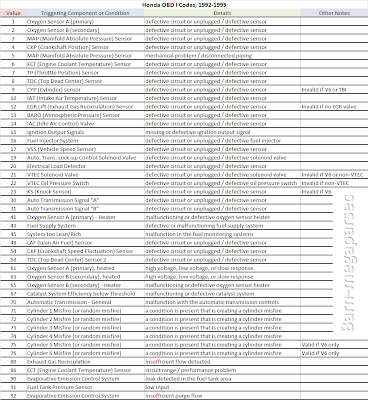
Hopefully this helps if you are in a situation similar to mine. I just had to learn this procedure a few days ago when my 1995 Honda's engine idiot light came on. I noticed that the engine would sometimes hesitate, so I wanted to figure out what was wrong as soon as possible. A friend referred me to the method for evaluating these codes. It threw me code 41: primary O2 sensor heater. So I turned to my Haynes manual and it told me to check it by disconnecting the output of the O2 sensor and checking the voltage across two of the terminals (check your service manual for detailed information about your vehicle), expecting about 0.9 V when warmed up, instead it read 0.04 V steadily, from cold to hot. Clearly the part was broken.
This is a very easy fix since the primary O2 sensor is right in the exhaust manifold up front, well within reach as long as you have the correct socket (which I borrowed from another friend, but if you want one, they can be found at Carquest for about $16.99). I replaced the primary O2 sensor, reset the battery, and the light did not come back on. When test driving it, it felt better. The problem was solved because the OBD let me know exactly what the problem was without having any detailed knowledge of the engine electrical system.
OBD I has two main advantages that make it pretty nifty for a shadetree mechanic.
The precursor to OBD II was, quite predictably, OBD I. It wasn't around for very long, and it wasn't as reliable, and it wasn't as useful, since each manufacturer did whatever they felt fit for reading the trouble codes.
For Civic and CRX models between 1992 and 1995 model years, the OBD I system was in place. For Accords, it's probably the same (although I am unsure, not having worked with them). Honda's particular method of getting OBD I trouble codes is slightly more advanced than simply plugging in a scanner.
- Pull up the carpet in the passenger footwell, around the right side (near the door).
- Notice on the right side: There is a jumper with at least two slots into which a wire can be inserted. With the ignition key in the OFF position, insert a wire or paper clip between these leads to jump it.
- Flick the key into the ON position, but do not crank the engine.
- If a status light flashes once very quickly, that is 1.
- If a status light flashes once for a longer period of time, that is 10.
- When the same status light turns off for a extended pause, it's done. Add the numbers together.
- It will repeat continuously, so if you missed it, just wait for the pause to end, and it will start over. If you have multiple codes, there will be a pause between each new code. Make sure you get all of them.

Hopefully this helps if you are in a situation similar to mine. I just had to learn this procedure a few days ago when my 1995 Honda's engine idiot light came on. I noticed that the engine would sometimes hesitate, so I wanted to figure out what was wrong as soon as possible. A friend referred me to the method for evaluating these codes. It threw me code 41: primary O2 sensor heater. So I turned to my Haynes manual and it told me to check it by disconnecting the output of the O2 sensor and checking the voltage across two of the terminals (check your service manual for detailed information about your vehicle), expecting about 0.9 V when warmed up, instead it read 0.04 V steadily, from cold to hot. Clearly the part was broken.
This is a very easy fix since the primary O2 sensor is right in the exhaust manifold up front, well within reach as long as you have the correct socket (which I borrowed from another friend, but if you want one, they can be found at Carquest for about $16.99). I replaced the primary O2 sensor, reset the battery, and the light did not come back on. When test driving it, it felt better. The problem was solved because the OBD let me know exactly what the problem was without having any detailed knowledge of the engine electrical system.
OBD I has two main advantages that make it pretty nifty for a shadetree mechanic.
- It doesn't need a scanner. So if you know how to do it, you can run codes yourself at home without buying any equipment. This means you can do true home maintenance with as little outside support as possible.
- It's less troublesome (No experience here, but I'm told this by reliable friends) if you want to modify your car. OBD II is considered to be more invasive and troublesome if you want to work on your engine in ways the manufacturer did not originally intend.
- The placement of the "port" is specific to certain vehicles. Not every one is the same. Because OBD II easily consolidated all the different systems, there was no reason to make mechanics learn something new that was manufacturer-specific. A better solution was possible, and quickly found.
- Customers balked at receiving diagnostic fees for simply having their codes read. Some unscrupulous dealers and other shops have billed customers for "dashboard disassembly" as part of the diagnostic fee, which vastly overstates the difficulty and time required to locate the port and read the codes, but customers may not have known any better, and it was at a point in time in which reading codes was novel, and the only alternative was a detailed physical inspection to learn the same secret.
- OBD II scanners provide more detailed trouble codes, and have more codes available.
- Adding up the codes by pencil and paper or memory is not hard, but if you're doing it 50 times a day, the extra time adds up.
Joke of the Day #10
Straight man:You shouldn't park here.
Speed freak: Why not?
Straight man: Bad part of town. They'll probably steal your radio.
Speed freak: Seriously? That's awesome.
Straight man, puzzled: Why?
Speed freak: I spend a lot of time lightening my car, and all I have to do is park in the right part of town and somebody will remove weight for free?
Straight man: ...
Speed freak: I'll just pop the hood. They can take the AC compressor if they want: lot of weight and it doesn't even work anymore!
Speed freak: Why not?
Straight man: Bad part of town. They'll probably steal your radio.
Speed freak: Seriously? That's awesome.
Straight man, puzzled: Why?
Speed freak: I spend a lot of time lightening my car, and all I have to do is park in the right part of town and somebody will remove weight for free?
Straight man: ...
Speed freak: I'll just pop the hood. They can take the AC compressor if they want: lot of weight and it doesn't even work anymore!
Monday, May 28, 2012
Memorial Day: 1000 views
Although I have never used this blog to point out days of interest, I would like to note that in the United States today is Memorial Day, which is a holiday during which
Americans commemorate those who have died in the US Armed Forces. The
sacrifice made by these individuals will never be forgotten by American
patriots, and their souls are the subject of our most fervent prayers.
Readers from around the world are invited to share if their nation also
has a similar custom.
Cumulative Barn-megaparsec readership hit 1000 views as of May 28, 2012. In internet terms, this is about as insignificant of a quantum of readership as can be measured. Still, I'd like to take a moment to thank all readers who have shown dedication enough to follow this blog in its current rough form for the past six months. I also welcome readers to offer their opinions in the comments. Thank you for your time. I look forward to many exciting new pieces during the summer.
Cumulative Barn-megaparsec readership hit 1000 views as of May 28, 2012. In internet terms, this is about as insignificant of a quantum of readership as can be measured. Still, I'd like to take a moment to thank all readers who have shown dedication enough to follow this blog in its current rough form for the past six months. I also welcome readers to offer their opinions in the comments. Thank you for your time. I look forward to many exciting new pieces during the summer.
Saturday, May 26, 2012
Condensed History of Video Games: Nintendo Seal of Quality (1984-1989)
This is part of a series. Please also see:
Condensed History of Video Games: From Tic-Tac-Toe to Pong (1952-1975)
Condensed History of Video Games: The Rise and Fall of Atari (1975-1984)
1984: The Nadir
Condensed History of Video Games: From Tic-Tac-Toe to Pong (1952-1975)
Condensed History of Video Games: The Rise and Fall of Atari (1975-1984)
1984: The Nadir
 |
| No joke- Atari buried tons of E.T. games |
When we left the story of the video game saga in 1984, the market was in shambles and there were serious doubts that it would ever return to its prior glory. The fear was that video games would pass away like the hula hoop and the Cabbage Patch Doll. No indications suggested that the best was yet to come, but as was the case in 1971 when Computer Space flopped, and 1977 when Pong got boring, 1984 was to be the darkness before the dawn of something better.
 |
| Atari 800 |
We haven't even discussed one of the biggest aspects of the video game crash. Video games earned their first foothold in homes at a time in which there were no personal computers. The 1981 introduction of the IBM PC did not have an immediate effect on this market, since it was too expensive for most households and it was basically a business tool. Graphics were a minimal priority from the start. But as cheaper offerings from Commodore, an improved Apple lineup including the new Mac for 1984, and cheaper PC clones from Compaq and others hit the market towards mid-decade, video games were a harder sell because they only offered entertainment and couldn't do business or education. These drawbacks often formed the topic of negative advertising. Why buy a game system that will ruin your children's minds, when you can nurture them with a home computer that can help them research, study, and learn how to use a computer? Ironically, nearly all of the video game makers, particularly Atari and Coleco, had cheap PC offerings as well, in the interest of diversification. The Atari 8-bit series (400 and 800 models) were also capable of playing some games, but they were full-fledged (although basic) computers. In the UK, Sinclair's dirt-cheap and feature-less ZX-80 and ZX-81 were prompting a British computer education boom that would inspire a new generation of British programmers.
 |
| Commodore VIC-20: A steal at $199 in 1982 |
The trend everywhere was for greater home computer ownership. That doesn't seem to conflict with video game ownership by modern standards, but in the early 80s, all of these were rather expensive propositions, and so it was a fairly well-off family that could afford both a home computer and a video game library in the slumping economy of the early 1980s. Moreover, the value of computer and video games in the home was still not yet proven; the idea was still novel. When faced with the option of getting a modern video game system or a modern computer, the question was easy for most families. They chose the home computer because it was capable of some tasks besides gaming. However, the machines of the day were unable to do some of the most simple tasks that we take for granted today. Home office technology was largely unavailable unless you had an expensive high-end PC. Needless to say, the World Wide Web did not exist yet, although there were rudimentary internet services like Prodigy.
If the home computer makers really knew their market, they could (and did) emphasize the game-playing ability of their machines to the same kids who would then pull the sensible side out when trying to get their mommies and daddies to fork over the cash for a new PC. All this was more fodder for the folks who insisted that the video game fad had run its course and it would never be so large again, at least not from the standpoint of dedicated consoles.
If the home computer makers really knew their market, they could (and did) emphasize the game-playing ability of their machines to the same kids who would then pull the sensible side out when trying to get their mommies and daddies to fork over the cash for a new PC. All this was more fodder for the folks who insisted that the video game fad had run its course and it would never be so large again, at least not from the standpoint of dedicated consoles.
 |
| Atari 2600 "Jr": yours for $49.99 |
One might be forgiven for assuming that Atari faded into oblivion after the Crash of '83, and that all we have are memories. Far from the truth! Atari had strong sales of its 8-bit computers after the crash and actually went into the black by the end of 1984. Throughout the 80s they eked out small profits on their lower market share, no longer driving the industry. If the 7800 (1986) and Jaguar (1993) were earnest attempts to regain their former control, nobody seemed to notice. The 7800 was simply nothing special, and the Jaguar was downright terrible. The bright spot in Atari's gaming portfolio continued to come from the old 2600, which was repackaged in 1985, when it was technically obsolete, and sold at a correspondingly low price of $50 since all the design and tooling was long paid for. Atari didn't stop making the 2600 until 1992, making it to this date the longest-lived home video game console. (However, Sony has pledged to build the PlayStation 2 for as long as demand exists, which means the PS2 will beat the 2600 if it survives beyond 2014.)
 |
| Atari 7800: Ready in 1984, delayed until 1986 |
The makers of video games are different from other companies. It is hard to think of a company in as enviable a position as Atari in 1982, when it was the fastest-growing company in American history. It's quite impossible to rationalize that level of growth with the level of contraction that would be experienced even two years later, when video game sales took a nose-dive into mid-70s levels. This level of boom and bust is intolerable to modern corporations. But it's the way the video game market was.
This is part of the magic of the video game industry. It is making a product that is imaginative in every single way. A developer attempts to make a world in which you interact, in which the controls make sense and the things you do onscreen are both pleasurable and meaningful. The appeal of video games is incredibly strong, and it doesn't require physical strength or massive intelligence to play most of the fun games available. The fact that such imagination is required to make games that click with the public, means that no company can hope to ride on past successes and cease to produce challenging, exciting, innovative new games. Even if the market has collapsed, even if the very name of video games has been tainted by poor quality releases, the video game developers still remain interested in their craft, and they will recombine into new companies or new organizations for the development of new and better games. We have learned that video games are not a fad and will never die.
_________________________________________________________________________________
Aside: My favorite company
 |
| It may be gray now, but the original was red, and I prefer it! |
I feel confident saying that I know the most magical company of them all, the developers of which have produced more smiles, laughter, and hours of entertainment in the last 27 years than Disney and 20th Century Fox combined. A company whose mascots have remained globally popular for decades and are known in nearly every country on Earth. A company that fought tremendous adversity to achieve every milestone of its journey, and has clawed its way back to the forefront of its field even after falling into a prolonged, depressing second-place for years. The famous names at this company have consistently produced masterful games, which have been critically hailed by adults and gobbled up by children alike, for the past 30 years. Part of me still feels like there must be some kind of holy collaboration that makes 90% of their games shine eternally.
 |
| ...and Mario movies too. |
 |
| Mario TV shows... |
Of course I am talking about Nintendo. Of all the companies in the entire world, not just confined to video games, I can think of none have had such a steady stream of high-quality creative output. I could wax lyrical about the effects that Nintendo had on my youth until my face turned blue. If I wanted to chronicle all the Nintendo games that have touched my life in some way, I would need to write a novel. You might say that this is just fanspeak. That I am a video game geek who is susceptible to this level of adoration. But the rest of the public might agree. As of May 2012, Nintendo has sold over 676 million video game systems worldwide, and over 3.6 billion video games. This is only to include those developed in-house and not the billions of others that were made for Nintendo systems by other developers. What other video game company has successfully turned its mascots into the stars of television shows (admittedly lackluster ones in the late 80s and early 90s) and even a Hollywood movie (Super Mario Brothers: admittedly terrible)? I can think of none. Mario doesn't have quite the star power now that he did at his earlier peak, but he's probably nearly as globally recognizable as Ronald McDonald. Even 10 years ago I would have said that Pac-Man was more iconic, but he is fading from the minds of today's younger gamers. Mario has faded very little. Each new release of a flagship Mario game is met with high praise and commercial success; even rehashes of old Mario games for a new system somehow retain their luster.
 |
| The Legend of Zelda (1986) for NES. |
For critical appeal, The Legend of Zelda might do somewhat better. I dare say that when it comes to making an impact through video games on those who couldn't care less to play them, Zelda has all the others beaten with its ridiculously catchy Hyrule overworld theme. Countless dads and grandmas and babysitters have caught an earful of their child's video game while doing something in the next room, and even my dad (who doesn't like Nintendo games) will say that Zelda has a pretty darn good tune.
Where did Nintendo begin? It stretches back decades before electronics were invented, and is a story for another article. The topic of this post is the legendary Nintendo effort in 1985 to launch its Famicom (Family Computer) in the United States. It chose to use its own company name proudly on the front and attach a generic "Entertainment System" to the back, resulting in the NES (Nintendo Entertainment System if you're an alien).
_________________________________________________________________________________
Looking back from 1980, you'd never believe Japan lost WWII.
There is a long history of famous Japanese debut efforts in the United States, perhaps because starting prices have usually been so low that even a half-decent effort will sell. Expectations were also low, as stereotypes that were inflamed by WWII took decades to subside. But when Honda first started selling motorcycles stateside in the 1950s, they were soon competitive. When AT&T started licensing its Bell Labs-developed transistor in 1952 for outside use, with a transistor radio following from Texas Instruments in 1954, the Japanese firms Sanyo and Sony were less than a year behind the Americans. They had a major market presence within a decade. Starting with Hitachi and Sanyo in the 1950s, and later bolstered by Sony, JVC, and Mitsubishi, the Japanese captured the bulk of the American television market by the 1970s. GE gave up on the market in 1986 (Magnavox and RCA about the same time) and Zenith, the last American maker of televisions (formerly the last American maker of transistor radios as well) went bankrupt in 1999. The market for personal radios was ultimately cornered by Sony with the Walkman, and that company also was at the vanguard of a successful Japanese assault on American stereo, speaker, and amplifier companies. Canon and other camera makers sold high-quality cameras stateside as early as the 1960s, and just recently (2012) put the legendary US firm Eastman Kodak out of business as well. Basically every appliance that can be named in the American kitchen or living room from microwave ovens to alarm clocks was pioneered by American companies, but US production was overwhelmingly usurped by Japanese makers of the same products. It usually took a long time, and often the first efforts were laughed at, but eventually the Japanese learned how to make the right product.
Japan's original post-WWII strength was its cheap labor, a condition which let it undercut the rest of the world in the cost of certain manufacturing (like transistor radios) until about 1965, when it too outsourced, this time to Hong Kong and ultimately Taiwan and mainland China. At about this time, a remarkable thing started to happen: Japan rapidly increased the sophistication of its engineering and it learned every lesson that America had to teach about business and organization, then started to usurp the former master. And yet Japan stopped producing anything at the lowest-cost. It would seem as though the companies and the nation were engaged in a continuous, harmonious push to make the badge "Made in Japan" itself a considerable asset.
Some manufactured goods, like automobiles, are still Japanese-produced, but for cheap products most of the labor done on the Japanese-branded products (as with most American-branded products as well) has been outsourced to China or Taiwan. In some cases Korea has taken over for Japan as the new up-and-coming manufacturing power, although it too outsources much of the labor to China. China has regulations that are basically unenforced, and they pay wages that undercut the entire world, with volume much more important than quality.
Unless you do a lot of research, you can't quite be sure how good the Chinese factory that makes the product is. The badge "Made in China" appears on everything from test equipment from manufacturers like Tektronix, to countless OE-grade automotive parts, to utter crap at flea markets and 90% of everything on the shelves at Dollar Tree. I can't say that Chinese stuff is all bad, because clearly they can make good stuff, but with the nature of production over there so secretive, it's hard to verify that an outsourcing manufacturer will actually give the Chinese factory of choice what it needs to compete, or if they will simply place an order and wait for the bidders to start fighting for the order to the tune of a few cents saved. That means, to a grumpy fart like me, that at least when you see "Made in Japan" or "Made in the USA", you can be reasonably guaranteed that it's good, since if it wasn't good the company surely wouldn't still be in business with the Chinese competition around.
Some manufactured goods, like automobiles, are still Japanese-produced, but for cheap products most of the labor done on the Japanese-branded products (as with most American-branded products as well) has been outsourced to China or Taiwan. In some cases Korea has taken over for Japan as the new up-and-coming manufacturing power, although it too outsources much of the labor to China. China has regulations that are basically unenforced, and they pay wages that undercut the entire world, with volume much more important than quality.
Unless you do a lot of research, you can't quite be sure how good the Chinese factory that makes the product is. The badge "Made in China" appears on everything from test equipment from manufacturers like Tektronix, to countless OE-grade automotive parts, to utter crap at flea markets and 90% of everything on the shelves at Dollar Tree. I can't say that Chinese stuff is all bad, because clearly they can make good stuff, but with the nature of production over there so secretive, it's hard to verify that an outsourcing manufacturer will actually give the Chinese factory of choice what it needs to compete, or if they will simply place an order and wait for the bidders to start fighting for the order to the tune of a few cents saved. That means, to a grumpy fart like me, that at least when you see "Made in Japan" or "Made in the USA", you can be reasonably guaranteed that it's good, since if it wasn't good the company surely wouldn't still be in business with the Chinese competition around.
Occasionally the Japanese tried too soon. Den Fujita, of Fujita, Inc., one of the first companies manufacturing transistor radios in Japan, soon had to learn that the American way of business meant that a contract was binding and that consistent quality was necessary if Japanese wares were ever to be more than gas station giveaways. His account is the subject of an interesting article in the Rutherford Journal.
As the earliest postwar Japanese entrepreneurs will note, Japan must concede that its pre-war methods of assembly and quality control were slightly updated versions of medieval production lines. The degree to which America outpaced Japan in production during WWII is damning evidence that they were many years behind in almost every category. American servicemen learned this firsthand from collecting Japanese small arms of WWII, with production quality varying from acceptable to absolute junk depending on who made it. German manufactured goods of WWII were different in that the production quality could be poor, but German designs were often cutting-edge, even in the final days of the war. Japan produced few modern designs as the war dragged on, and most of these were with support from the Germans.
When Toyota originally began selling cars in the US in 1957, their offering (the first-gen Crown) was far too small, underpowered, and flimsy to cope with American highways, and the thing quickly became laughingstock. Such was the negative response to this attempt, that it was to set the Japanese car export business back years. The car market was a tough nut to crack, but by the mid-70s, the Japanese had a largely competitive set of offerings, anchored by the sensible Honda Civic and later Accord. Although Japan became a semiconductor player by the 1970s, the Japanese did not experience the flourishing of independent PC builders in that decade like the United States did, and when there was a popular offering in the early 80s (the MSX) it was a Microsoft design with an American Zilog processor. With the sole exception of the odd Sony laptop, no Japanese brand has made itself strongly felt in the American market for PCs. Japan also had a tough time exporting its taste in television shows and film to the United States; it would take massive hits like Pokemon in the 1990s to bring anime out of the fringes and into the American mainstream. Starting in the immediate aftermath of WWII, the American soft power (cultural influence) has had a profound effect on Japan that continues to this day, while conversely the Japanese have usually not attempted mainstream cultural exports to the United States. Some manufactured goods markets have seen almost no Japanese penetrations whatsoever, like firearms, full-size pickup trucks, medical equipment, and mainframe computers. The first two (guns and trucks) have become the haven for a certain type of American patriot; it absolutely makes sense that in this market the Japanese wouldn't be highly welcome (Tundra and Titan sales are never class-leading). Still, I always found it strange that the United States was able to stay ahead of Japan in terms of semiconductor technology, processor development, and concentration of computer science talent. Japan never had a full-scale competitor to Wintel for the home market or IBM for the professional or mainframe market. As for medical technology, perhaps this is due to some kind of import regulation; I am unqualified to guess. Maybe in the year 2012 they've done all the conquering they ever plan to.
One horizon remained uncharted in 1985: the American video game market.
_________________________________________________________________________________
1985: Dawn of a New Era
Following in the grand tradition of Japan entering with an unknown name into a market that had formerly been invented by Americans and consumed mostly by Americans, Nintendo decided to start selling its Famicom (Family Computer) in the USA. The dinky original name would have to go. In its place they gave it the rather generic moniker of Nintendo Entertainment System, using the same nomenclature as their predecessors Fairchild and Atari had done. But the NES was something truly special, definitely moreso than any systems that came before it. And amazingly, the traditional virtues of Japanese manufactured goods were NOT what made it special. It didn't sell well because it was the most technically advanced product, or because it was the cheapest, or because it was the most reliable. Come to think of it, the NES is a fairly unreliable system that requires special tricks to keep going, and because it was an 8-bit machine with another MOS 6502 that had powered video game systems for years already, it didn't seem really advanced. At $149 launch price (with a game and two controllers) it was actually slightly more expensive than the Atari 7800, and a whopping $100 more than the stale Atari 2600. So what are the virtues of this machine?
 |
| NES in original 1985 trim. |
The paradigm shift here is that finally a Japanese firm had conquered the market without emulating its competitors for a lower price or better quality. They did not cut costs to the bone to make the greatest value. They did not simply focus on better construction. They didn't copy existing work and improve it. They were genuinely innovating, and they were selling a system on its desirability, not on its sensibility. They were poised to develop the best video games ever made. This machine was not to fill a gap in the market. It was to revitalize the market, and expand it to new heights it had never known before.
The key strengths of the Nintendo Entertainment System are so well-known that it seems almost silly to rehash them. But for the benefit of younger readers, I have summarized them from my outlook.
 1. Exclusive high-quality titles. Nintendo knocked it out of the park immediately with Super Mario Brothers in 1985. They followed it with Metroid, Legend of Zelda, Super Mario Brothers 2, Super Mario Brothers 3, and a slew of popular sports games. Their subidiary HAL Laboratories also introduced the character Kirby on this system. Most of the content for the NES was exclusive, because Nintendo knew it had a winner and it demanded that all developers develop solely for Nintendo, or not at all. The degree of exclusivity ended all ambiguity about which video game system was worth buying. The classics for the NES are why it was popular and why it remains famous today. It was the launchpad for Mega Man, Castlevania, Contra, Metal Gear, Final Fantasy, Dragon Quest, and countless other series.
 2. Restoring confidence in the market. Perhaps the biggest change that the customer noticed was that Nintendo gave you a basic guarantee on each licensed game you bought. This came in the form of the "Seal of Quality", which meant it had been tested by Nintendo and it was guaranteed to work and play somewhat well. It wasn't a guarantee that you'd love the game, but at least it always played and you'd get a few minutes of enjoyment. In truth, the Seal just meant that that game was the product of developers who wanted to play ball on Nintendo's terms and designed a video game that would work around the NES's lockout chip (called 10NES). But this tactic was amazingly effective at getting buyers to trust video games again after the bad taste in their mouths from the flurry of third-party titles for the 2600. Since no such "guarantee" had ever been offered before, the Nintendo Seal would become famous in its own right as a symbol of how the new generation of games was superior to the old.
 3. Nothing but the best from the start. From the beginning, each NES had a pack-in game, which was a novel feature at the time. It was also a fine choice that it was Super Mario Brothers, a superbly fun and approachable game for the entire market. This feature let new console owners immediately gloat over how fun their game system was. It took the guesswork out of choosing games. Everybody knew that if you bought the system, you got a fun game right off the bat. It was a fantastic idea. Launching a game system with at least one "killer app" from the start was increasingly viewed as essential to the success of a new system, since buyers would wait until an anticipated game was available to buy the system in the first place.
4. The best marketing ever. Nintendo marketed its mascots ruthlessly, taking advantage of television commercials, radio, cereal boxes, magazines, billboards, TV shows, and an endless onslaught of merchandise. It was impossible to avoid hearing about Nintendo in the late 80s.
5. A carefully cultivated image. Nintendo pulled an old Atari trick in positioning the NES as a family game system. The advantage of this over a PC was that it involved the whole family in good, clean fun, which is more than could be said for solitary PC gameplay. Compared to the NES, there was no PC which had anything like the amount of exclusive, high-quality video game titles. Moreover, unlike Atari, Nintendo could actually back up its image with fact, since the lock-out feature meant that it was very hard to design bootleg games, and consequently the fly-by-night adult game makers and blatant product placement games were barred from the system, and never even made it onto shelves to sully the system's reputation.
6. Better graphics and sound. It might have had a fairly old processor, but the NES was more advanced than anything that had previously used it and it blew the Atari 7800 out of the water. There were more colors, significantly better textures, more memory on the machine and more ROM on the cartridges for longer and more involving games. It would be easily eclipsed by its 16-bit successors, but for the first time reasonably accurate sound and pictures were possible. We were not quite to the point of the spoken voice, but background music became genuinely likable, not just a series of burps and beeps like it was on the 2600. Some basic tunes from the NES days still live with us today, like the Zelda and Mario theme songs.
 7. A perfect game controller. It has never really been bettered and it set the template for the future. A d-pad on the left, start and select buttons in the middle, and action buttons on the right. All controllers since then have followed a somewhat similar layout, at least to the extent of directional control on the left and action on the right. The d-pad was a great advance over earlier joysticks.
8. A respectable appearance. The only positive aspect of the NES that came with the front-loading slot is that it looked like a VCR, which at the time was a cool piece of technology. Compared to the top-loading Atari systems, the front-loading NES seemed more modern at the time. With its boxy exterior and muted colors, it looked more like a serious addition to the living room than a full-on kid's toy. This was an improvement over the Famicom, since the Famicom was sold in Japan with exactly the kind of Fisher-Price hues that would have ruined its appeal to adults in America.

10. Sheer good luck? Nintendo took advantage of a lot of recently-formed development firms that were hurting from the Crash and needed to get games published and so would accept any terms available, including exclusive deals. Nintendo got Tetris as an exclusive even though it was not their own creation, and this was typical. Very many still-popular series were started on the NES over 20 years ago. It's just an incredible outpouring of creativity.
11. Winning a few key cases. One of the few legal thorns in Nintendo's side was Tengen (an Atari subsidiary), which succeeded in cracking the 10NES lockout chip without making licensed games. If this was done purely by reverse-engineering, it would have been fully legal under the Activision precedent (you can't stifle third-party developers). However, since Tengen had requested and viewed code for the 10NES chip from the US Patent Office, they had no way to prove that it was honest reverse-engineering. The courts ruled that their workaround was copyright infringement and prohibited. Nintendo also won the case against Tengen over Tengen's version of Tetris. Even though it was not at all based on the source code for Nintendo's version, and was built from scratch, it was disallowed because Nintendo had exclusive rights to a game by that name and with that type of gameplay. All of this is rather sad, because Tengen's titles for the NES, particularly their highly polished Tetris, are considered classics.
12. Better retention of its best people. Nintendo was not a labor camp like Atari under Kassar, but even if it was, the Japanese are seemingly not as inclined to shop around for a new job as Americans. Hiroshi Yamauchi, Nintendo's president from 1949 to 2002, pushed his engineers and developers to their limits but rewarded them appropriately. He spent almost his whole adult life from age 22 running the company after the death of his grandfather (then the current president). He also displayed a remarkable amount of intuition as to what approach was best in game design, despite having no background in it. Whatever he picked was usually a winner. In part because of this nurturing management, Nintendo has retained its heroically prolific developer Shigeru Miyamoto to this day. The Miyamoto-Yamauchi relationship was crucial to the success of Nintendo.
 13. Some good peripherals. I'm looking at you, Light Gun. How many joyful hours I did spend playing Duck Hunt as a youth and being AMAZED at how it worked when it was made before I was even born.
14. All of the expected technology. It did everything relatively well, as you'd expect from a 1980s Japanese product. It had a pause feature, which had been introduced three years earlier on the Atari 5200. Apart from the quirks of the cartridge loading system, it had no quirks that would put off a neutral observer. It could play on color or B/W televisions. It had ordinary power and reset buttons. It had RF connectivity as well as composite A/V connectivity (later removed for the SNES and not brought back until years later on the N64). The power supply was a simple one-piece AC adapter. It was easy to open the case to make repairs if one so wished. Many historical video game systems we already saw have been plagued by some silly oversight that turned into a glaring fault. But though there were drawbacks, Nintendo didn't tend to drive anyone away to its competitors; by and large, the people who bought other systems either couldn't afford an NES or were dead-set in their buying habits already.
When the NES hit the market in 1985, a frosty reception was expected by most experts. In spring 1985, despite the fact that Famicom had sold 2.5 million units in Japan, Electronics Games magazine noted that the "video game market in North America has virtually disappeared" and suggested that Nintendo was erring in introducing the NES to the US market at that time. The first limited release of the system was October 18th, 1985. Complete nationwide sales would not start until February 1986.
It's staggering to think how far off the mark they were! By the time NES production ceased in 1995, nearly 62 million systems had been made. Nintendo's record of 62 million games sold would be the world's best for years until overtaken by the PlayStation in 1999. By comparison, the Atari 2600 had sold less than one-fourth of that during its period of dominance up to 1984, and actually sold more units when re-released in the mid-80s. The total of Atari 2600s was about 30 million sold in 15 years, roughly half the number of NES systems sold in 10 years stateside (12 years in Japan). The fact that the old Atari 2600 was doing better business after Nintendo than before it, suggests that Nintendo legitimized the video game once again. After the NES, there would be no crashes. Video games would continue to sell well indefinitely.
It's staggering to think how far off the mark they were! By the time NES production ceased in 1995, nearly 62 million systems had been made. Nintendo's record of 62 million games sold would be the world's best for years until overtaken by the PlayStation in 1999. By comparison, the Atari 2600 had sold less than one-fourth of that during its period of dominance up to 1984, and actually sold more units when re-released in the mid-80s. The total of Atari 2600s was about 30 million sold in 15 years, roughly half the number of NES systems sold in 10 years stateside (12 years in Japan). The fact that the old Atari 2600 was doing better business after Nintendo than before it, suggests that Nintendo legitimized the video game once again. After the NES, there would be no crashes. Video games would continue to sell well indefinitely.
 |
| NES-101, the updated version |
The system was still selling well enough after eight years that Nintendo pulled an old Atari trick and re-released it in October 1993, two years after they had already started selling its replacement, the Super Nintendo. To keep the old system viable, the price was dropped to $49.99, exactly the same as the re-released 2600 of six years earlier. They gave it an updated controller (referred to as the "dog bone" by fans) which embraced the rounded style of the SNES controller. The system itself had a more reliable top-loading layout, also similar to the replacement SNES. Because the NES was quite old and there was little desire for pirated games, Nintendo omitted the lockout chip, so illegal games that had been sold earlier could be played on this version. Happy days- now any Tengen game is playable. More critically, this new system wasn't as likely to freeze or fail to load the game due to poor pin connections failing to verify the game's authenticity. However, these systems are not really in high demand. The internal code for this system is NES-101. For those who are interested, the original NES was coded NES-001.
The NES-101 is a more practical system, but it lacks the bulk, presence, and retro-chic appeal of the original NES-001. It looks a bit bland to behold. But for the lower-middle class that had never considered buying video game systems before, the $50 NES in 1993 was doubtless a gateway for millions of video game players.
Why isn't the redesign considered "cool"? It comes from a time when the NES was fading from memory. The 16-bit generation, anchored by the Super Nintendo and Sega Genesis, would make the old NES seem boring and uncomplicated; the "retro" appeal didn't gain motion until years later, and the original 001 design was inevitably preferred because it was truer to the heart of the 80s. The 101 did the same thing better, but was from the wrong decade. For those who shun emulators and just want a reliable way to play old NES games without getting into the hype of the original classic design, the re-released 101 version remains appealing, and it's definitely cheaper than the original VCR-style model. Likewise for the dog-bone controllers: they are more ergonomic than the sharp-edged original, and have better buttons, but they too are low on style and retro appeal. I'd like to say that style doesn't matter, but the original NES is the real deal, and it's hard to argue with the aesthetic appeal of it. For me I'd prefer to have both, but since I don't, I'm glad that I have the original.
The NES-101 is a more practical system, but it lacks the bulk, presence, and retro-chic appeal of the original NES-001. It looks a bit bland to behold. But for the lower-middle class that had never considered buying video game systems before, the $50 NES in 1993 was doubtless a gateway for millions of video game players.
Why isn't the redesign considered "cool"? It comes from a time when the NES was fading from memory. The 16-bit generation, anchored by the Super Nintendo and Sega Genesis, would make the old NES seem boring and uncomplicated; the "retro" appeal didn't gain motion until years later, and the original 001 design was inevitably preferred because it was truer to the heart of the 80s. The 101 did the same thing better, but was from the wrong decade. For those who shun emulators and just want a reliable way to play old NES games without getting into the hype of the original classic design, the re-released 101 version remains appealing, and it's definitely cheaper than the original VCR-style model. Likewise for the dog-bone controllers: they are more ergonomic than the sharp-edged original, and have better buttons, but they too are low on style and retro appeal. I'd like to say that style doesn't matter, but the original NES is the real deal, and it's hard to argue with the aesthetic appeal of it. For me I'd prefer to have both, but since I don't, I'm glad that I have the original.
Of course, there are some drawbacks to the NES, but over time everyone's memories of the negativity has faded, and we now view them as charming personality quirks.
- Stupid way of inserting cartridges. The push in and push down method puts undue stress on the pins connecting the game to the system. Over time they can stop developing a flush fit, resulting in data loss, which is when your game crashes or won't even start in the first place. We have reclaimed this as a "cool thing" because of the art of getting it to work correctly. Always make sure you blow on the cartridge frequently! Even if the dust is invisible, we still pretend it's there. There is a better workaround because you can buy a new connector that will replace these pins, and it's easily replaceable with just one screwdriver. The part is widely available and inexpensive. The rest of the system is pretty reliable.
- Stupidly big cartridges. When you pull one of these out today compared to a DS or Game Boy Advance game, or Wii disc, you might be forgiven for thinking you've accidentally stolen one of the tablets of the Ten Commandments. It's huge, gray, and heavy. Even for the day, these were monsters. The chunkiness doesn't make it particularly tough; you still need to be careful about temperature and moisture with cartridge-based games.
- The Flashing Blue (or Gray or White or Green) Screen of Death. Nintendo's effective solution to exclude unlicensed developers was to include the 10NES lock-out chip on the console, which would not play a game unless it had constant contact with all the pins of the game so that it could communicate with the internal chip, which contained memory that let the system know that it was legitimate. If any pins were bent or broken, and contact was lost, it might assume the game was unlicensed, and the screen would flash once per second, because that was the refresh rate of the 10NES chip. The blue screen was by far the most common, but other colors were possible. (Usually solid, not flashing. If you see a flashing green screen, take a video, because it's rare.)
- In Japan, the Famicom's controllers were hardwired to the machine. Ouch! Didn't they learn anything from Fairchild? But happily, for the US release, we got removable controllers.
- Silly peripherals. Some have credited the R.O.B. (Roboting Operating Buddy) as being a "Trojan Horse" by showing an entirely new facet to video games that made it appealing despite the fact that Nintendeo never intended this robotic peripheral to replace conventional controls. I have never used one, never seen one, and honestly I don't know why anyone was interested. It sounds and looks stupid. The Power Glove looks cooler, but holding your arm out at a 90 degree angle for hours sounds like an even worse idea. This is just my opinion...
_________________________________________________________________________________
The others
Nintendo did not operate in a vacuum, but very nearly. Of course Atari was still present in the video game market, and in the early days of the NES it was hoped by that company that it could leapfrog Nintendo with its 7800 and get back in the game. That proved to be hopelessly optimistic. The Atari name held little appeal for modern gamers in the late 1980s. By 1991, when Atari was wrapping up the 7800 project, they held perhaps 12% of the North American game market, their home territory, while Nintendo held 80%. In Japan, the Atari 7800 was almost unknown, and Nintendo's margin of victory was even greater.
I have never played a 7800, and not much is written about its unique content. It wasn't heavily mourned; the best birthday present it ever got was a re-released "Atari Flashback" in 2004 which had only five 7800 games and controllers that were identical to the 7800's. Since this system didn't actually use the same internal CPU or graphics, it was said to not "feel" the same as the original 7800, which consequently dimmed its appeal. We've already been over the 2600 hits, and most of the 7800 main titles were just rehashes, so there's little more to talk about here. Atari managed a surprising degree of success with the 7800 considering how uninspired it was. They sold almost 4 million, and that was purely on the American market. I don't know if they even bothered to sell it anywhere else.
 |
| Atari "Flashback" from 2004. |
 |
| Master System: hefty and unique, but poor selection of games. |
 |
| Master System II: So generic I'm falling aslee....zzzzz |
Sega was definitely looking over the shoulder of Nintendo's Famicom when they selected a D-pad (well, more like a tiny joystick that was almost like a D-pad) and two-button layout for the Master System gamepad. Unfortunately, they didn't copy it thoroughly enough. Amusingly, the controller cord comes out of the right side of the controller, which is exactly where your right hand would be. I have to just stand back in amazement that some Sega executive would be idiotic enough to pass this design on to final production. If anyone played it even for a short period of time, they would see that this design was complete garbage. Sega pulled the same dimwitted failure years later with the Dreamcast, which had controllers with the cord coming out of the back, meaning you had much less cord length. How can you make such a huge mistake twice? What were they smoking at Sega?
However, this system is fondly remembered by some. We should point out that it is technically superior to the NES, with its Zilog Z80 beating out the older MOS 6502 used in the NES. Still, potentially superior graphics was no substitute for third-party support, and Sega was entering a market where Nintendo had an overwhelming supply of hits from its own manufacturers, and exclusive rights to many third-party games too. Sega had an uphill battle, and with a development team much smaller than Nintendo's, they could only churn out a couple of high-quality first-party titles, which wasn't enough to carry the system to success.
I have never personally owned the SMS and haven't logged much gameplay, so I can't comment in too much detail. The best-selling game (and, by consensus, the highest quality game) was Alex Kidd in Miracle World. In the pre-Sonic days, this was Sega's best platforming effort and nearly a competitor to Super Mario Bros. There is something to be said for variety, and if you ever just wished that folks would shut up about Mario and Mike Tyson's Punch-Out, here was your choice if you wanted something a bit less antediluvian than Atari.
But although I will bash Sega, I have no doubt that they were utterly committed to taking on Nintendo on equal terms, which was a courageous objective. Their first effort was nowhere near good enough. But when 1989 rolled around, just halfway through the life of the NES and Master System, they would strike back with the wildly successful Genesis, their biggest-seller of all time. The "16-bit generation" was going to witness Nintendo remain the industry leader (helped by the 1989 release of the legendary Game Boy) but never with the degree of total control that it enjoyed from 1985-1989. Stay tuned to see it unfold.
Subscribe to:
Posts (Atom)